JWST SPIES A WARM HAZY JUPITER ORBITING A DEAD STAR
Astronomers have measured the atmosphere of a planet orbiting a white dwarf for the first time, and it is surprisingly warm and full of methane.
by editor7 min readcomments soon
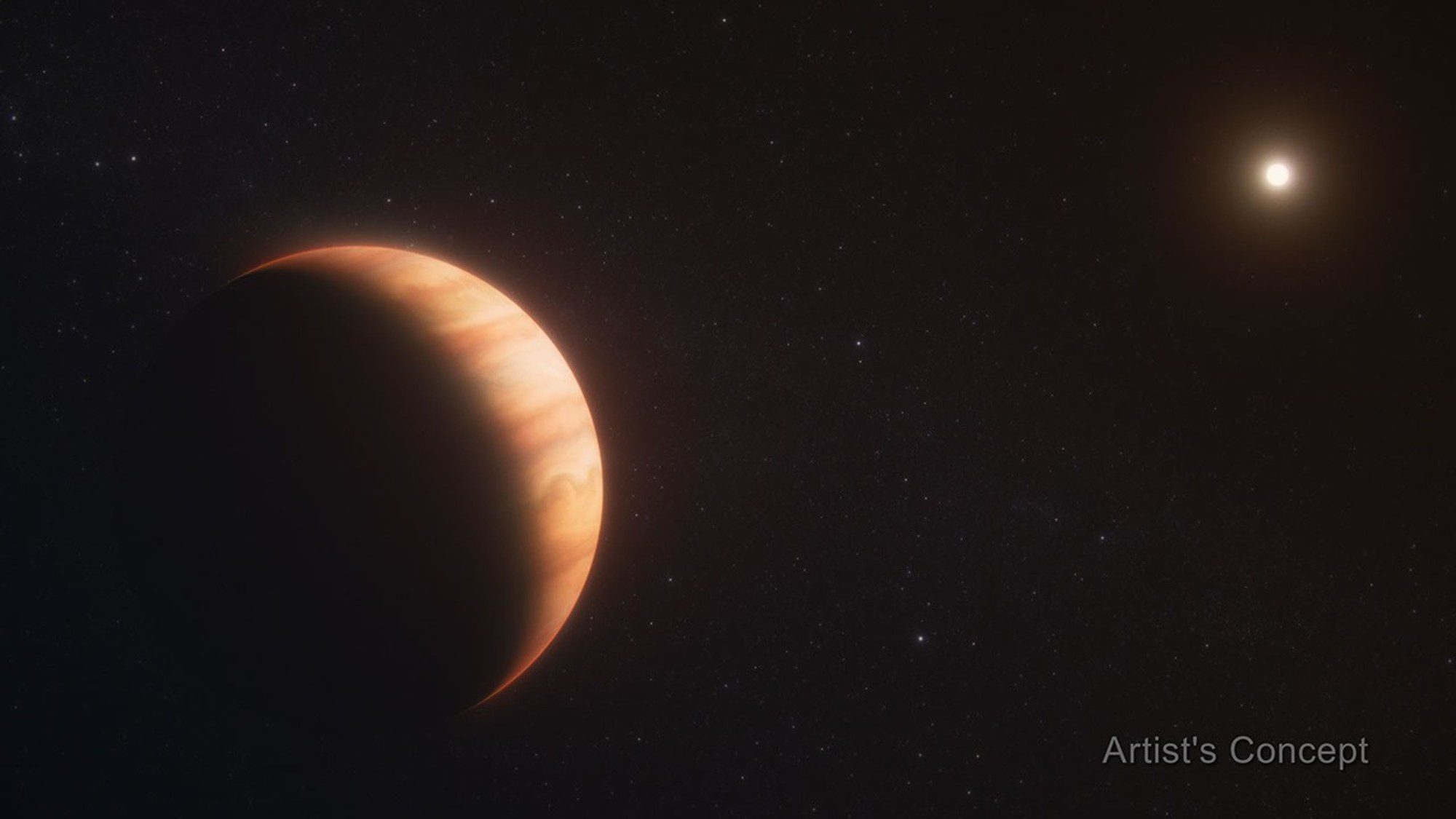
The James Webb Space Telescope has done something no telescope has done before. It measured the atmosphere of a planet orbiting a dead star. The planet is a Jupiter-sized world called WD 1856 b, and it sits just two million miles from the shrunken core of a star that once looked a lot like our Sun. The atmosphere is thick with methane and veiled in haze. And the planet is significantly warmer than it has any right to be.
The results, published Wednesday in Nature, are the first direct look at what happens to a planetary system after its sun goes dark. They are also a preview of what our own solar system might look like in about five billion years.

A PLANET SEVEN TIMES BIGGER THAN ITS STAR
WD 1856 b orbits the white dwarf WD 1856+534, a stellar remnant about 80 light-years from Earth. The white dwarf is about the size of Earth. The planet is about the size of Jupiter. That makes the planet seven times larger than its star, a ratio that is as strange as it sounds. "The planet is about the size of Jupiter, but the white dwarf it orbits is the size of Earth, so the planet is seven times larger than its star."
The exoplanet was discovered in 2020 by NASA's TESS and Spitzer telescopes, but the new Webb observations go far beyond a detection. By watching the planet transit its host star, an international team of astronomers measured its temperature and picked apart the molecules in its atmosphere. They found a temperature of about 260 degrees Fahrenheit (126 degrees Celsius) and a chemical signature that points to small cloud particles and hydrocarbons, most likely methane. "We saw the telltale signatures of small cloud particles and hydrocarbons, most likely methane, which is the first time we have seen an atmosphere on a planet transiting a dead star."
This is the first time an atmosphere has been seen on a planet transiting a dead star. The team includes researchers from the University of St. Andrews, Northwestern University, and Cornell University, among others.
THE MYSTERY OF THE HOT PLANET & COLD STAR
The star is dead. It no longer fuses hydrogen. It radiates only residual heat, slowly cooling for billions of years. A planet so close to such a faint object should be cold. WD 1856 b is not cold. Its surface temperature is roughly 260°F, far warmer than the white dwarf's feeble glow can explain.
The extra heat is residual, locked in from a much more violent time. Computer models show that the planet did not always orbit here. It could not have. If WD 1856 b had been this close when the star was still a red giant, it would have been swallowed and destroyed. The planet must have arrived later, after the star collapsed into its white dwarf, and the migration was not gentle.
As the planet spiralled inward, the white dwarf's gravity squeezed and flexed it like a stress ball. That tidal heating raised the planet's global temperature. "As the planet moved inward, its interactions with the strong gravity of the white dwarf will have caused it to warm up considerably, and it has been cooling ever since," Christopher O'Connor of Northwestern traced the temperature back in time and found that the heating most likely happened between 3 and 5.5 billion years after the star became a white dwarf.
HOW A JUPITER SURVIVES THE DEATH OF ITS OWN STAR
There are two main theories for how WD 1856 b ended up in its present orbit. One is that it was engulfed by the red giant star and somehow survived inside the star's outer layers, later emerging as the star shed its envelope. The other is that gravitational interactions with other bodies in the system pushed it inward. The white dwarf is part of a triple star system, so companion stars could have disturbed the planet's orbit. "The big question is how WD 1856 b ended up where it is today, and there are two theories. One is that the planet was swallowed by the host star as it was dying, and managed to survive on the inside. The other is that migration took place due to the gravitational effect of other objects in the system. The white dwarf is part of a triple star system, and the companion stars could have influenced WD 1856 b’s orbit."
The new data favour the second scenario. If the planet had been swallowed and then survived, the heating event would have happened much earlier, and the planet would have had billions of years to cool back down to equilibrium. The fact that it is still warm today suggests the migration happened later, long after the star was dead, driven by the gravity of other objects.
That timing is crucial. It means planets can survive the death of their host star and then, through a slow choreography of gravitational nudges, find their way into orbits that would have been impossible during the star's life. It also means that the heat we see today is not ancient starlight, but the lingering trace of a long and violent reshuffling.
WHAT THIS MEANS FOR YOU AND I
Our Sun will run out of hydrogen fuel in about five billion years. It will swell to more than 100 times its current size, becoming a red giant. Mercury and Venus will be engulfed and destroyed. Earth will probably be engulfed too, or at least scorched to a crisp. Jupiter and the other outer planets could survive the red giant phase, but their orbits could change.
What Webb has given us is a real example of that future. "We’re used to looking back in time when we use telescopes, but this is the first time we have been able to look forward to what might happen to the outer planets around the remnant of a Sun-like star," Ryan MacDonald of the University of St. Andrews put it plainly: we are used to looking back in time with telescopes, but this is the first time we have been able to look forward to what might happen to the outer planets around the remnant of a Sun-like star.
Jupiter is roughly the same size as WD 1856 b. It sits about five times farther from the Sun than Earth does, far enough to avoid being swallowed when the Sun expands. But after the Sun becomes a white dwarf, Jupiter's orbit could evolve. It might drift inward, closer to the white dwarf, and in doing so get heated up by tidal forces. It might even survive with an atmosphere rich in methane and haze, just like this one.
That is not a prediction. It is a scenario, drawn from the first real data scientists have ever collected on a planet orbiting a dead star. Before this study, astronomers knew such worlds existed but had almost no direct information about them.
FOR NOW, ONE THING IS CLEAR
The Webb observations of WD 1856 b open a new window into the late stages of planetary systems. There are likely many more such worlds waiting to be studied. Every one of them is a time capsule from the end of a solar system's life, carrying information about how planets rearrange themselves when their star goes quiet.



A gas giant planet can survive the death of its star, drift close to the stellar corpse, heat up, and develop a hazy methane atmosphere. It is not a pretty picture. But it is the most vivid look we have ever had at what will happen to the planets in our own backyard, long after the Sun has burned out.
what did you make of it?
more from space
space
SPACEX ABORTS STARTSHIP FLIGTH 13 AFTER ENGINES FAIL TO IGNITE
An automatic abort kicked in when some Raptor engines on the Super Heavy booster didn't light; two engines will be replaced before the next try.
space
FFC APPROVES SPACE MIRROR: REAL ISSUE IS THE OTHER MILLION SATELLITES
Reflect Orbital gets a license to test sunlight reflection, while SpaceX files for 40 times as many satellites as have ever been launched.
space
ISPACE BUYS 500KG OF PAYLOAD SPACE ON LUNAR LANDER STARSHIP
The Japanese firm will develop a rover to deliver customer payloads up to a few kilometers across the lunar surface, targeting a 2030 launch.
space
ASTRONOMERS SAY 1.7MN SATELLITES WOULD DESTROY GROUND BASED ASTRONOMY
A new ESO study calculates that proposed megaconstellations would make large telescope images unusable for hours each night.