SPACE SUGAR? ASTRONOMERS FIND FOUR-CARBON SUGAR IN DEEP SPACE
The discovery of erythrulose in a molecular cloud raises new questions about how prebiotic chemistry gets seeded across the galaxy.
by editor4 min readcomments soon
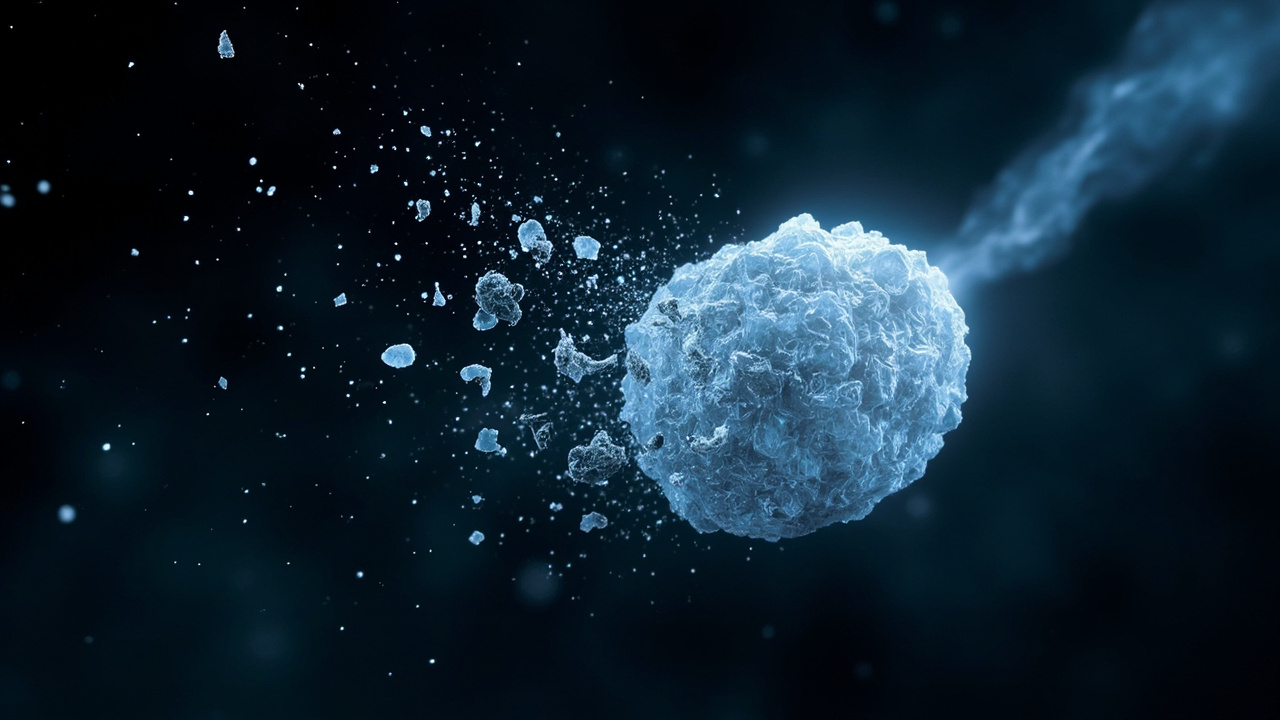
The space between stars is not empty. It is a vast chemical laboratory where radiation, cosmic rays, and frozen dust grains collaborate to build molecules that, on Earth, are the stuff of life. A new paper documents the discovery of , a finding that complicates our understanding of how the building blocks of biology arrive on young planets.
The sugar is called erythrulose, a four-carbon ketose detected in the molecular cloud G+0.693-0.027 using the 40-meter Yebes telescope and the 30-meter IRAM telescope. The detection carried a 0.2% chance of being random, a statistically rigorous signal that the molecule is genuinely present.


WHAT DID THEY FIND EXACTLY
Erythrulose is a four-carbon sugar, making it larger than the two-carbon glycolaldehyde and three-carbon glyceraldehyde that researchers had previously catalogued in interstellar clouds. Its presence is notable for what surrounds it: no three-carbon sugars were detected in the same cloud. That absence is itself a puzzle.
The researchers used quantum chemical models and Kinetic Monte Carlo simulations to reconstruct how erythrulose might form in the harsh environment of an interstellar cloud. The answer: two-carbon fragments combine on the icy surfaces of dust grains, which are constantly bombarded by cosmic rays and atomic hydrogen. These impacts shatter molecules into radical fragments that reassemble in unexpected configurations. The process bypasses the need for a three-carbon intermediate entirely.
Erythrulose was measured at roughly eight times the abundance of its three-carbon analogs like glyceraldehyde. That ratio is a clue. If sugars built up one carbon at a time, you would expect to see the smaller molecules first. Instead, the chemistry appears to favor recombination of fragments, letting larger sugars emerge without their smaller cousins.
WHY "FOUR-CARBON" MATTERS
DNA and RNA use a five-carbon sugar backbone called ribose. Ribose has been notoriously difficult to synthesize under plausible early Earth conditions. It is fragile, reactive, and tends to fall apart before it can incorporate into a growing polymer. This has driven interest in alternative genetic backbones.
Threose Nucleic Acid (TNA) uses a four-carbon sugar called threose instead of ribose. TNA is a leading candidate for a precursor genetic polymer because it can store and transfer information like DNA while being chemically simpler to produce. The detection of erythrulose now provides a direct chemical link to that pathway.
Ketose sugars like erythrulose can transform into aldose sugars like threose in the presence of liquid water. That isomerization step, which swaps the position of a hydrogen and oxygen atom on the sugar's carbon chain, is straightforward chemistry once the right conditions arrive. The four-carbon backbone does not need to be built from scratch on a planetary surface. It could arrive pre-formed.
DELIVERY MECHANISM
Large amounts of sugars were deposited on Earth during the Late Heavy Bombardment, a period roughly four billion years ago when asteroids and comets rained down on the early planet. By the time Earth's oceans cooled enough to allow liquid water, plenty of erythrulose was already available in the inventory of delivered organics.
The implication is striking: The detection in G+0.693-0.027 demonstrates that the chemistry is not rare or accidental. It is a reproducible outcome of the conditions that prevail in the spaces between stars.
The molecular cloud where erythrulose was found is near the galactic center, a region dense with the raw material for future star systems. Whatever emerges from that cloud in the next few million years will inherit a chemical heritage that already includes the building blocks of genetics.
WHAT SCIENTISTS STILL DONT KNOW
The detection opens several questions that will guide the next phase of astrochemical research. First, how common is erythrulose? A single detection in one cloud could be an anomaly. If follow-up observations find it across multiple star-forming regions, the implication shifts from interesting to expected.
Second, can the same process produce five-carbon sugars? Ribose is the missing piece. If four-carbon sugars form readily through fragment recombination, the five-carbon backbone of DNA and RNA may not be far behind in the chemical sequence.
Third, what happens to these molecules during planetary formation? The journey from interstellar dust grain to cometary nucleus to planetary surface involves heating, impacts, and radiation exposure. How much of the sugar inventory survives intact is still being modeled.



The paper representing this discovery is available on arXiv, where it joins a growing body of work mapping the prebiotic chemistry of the interstellar medium. Each new molecule adds a piece to a puzzle that began assembling long before the Sun ignited.
what did you make of it?
more from science
science
IBM UNVEILS SUB 1NM CHIP WITH 100 BILLION TRANSISTORS
A new nanostack architecture doubles transistor density over the 2nm node, adding 10-15 years to the semiconductor roadmap.
science
ARXIVLABS OPENS PREPRINT SERVER FOR COLLABORATIONS
arXiv invites outside developers who share its values of openness, community, excellence, and privacy.
science
NOAA CONFIRMS El NINO IS HERE, COULD BE THE STRONGEST IN 140 YEARS
Oceans have absorbed 23 zettajoules of heat in recent years, the equivalent of 365 million atomic bombs. Now the climate system's best-known disruptor is loading…
science
SCIENTISTS DISCOVER OLDEST WHALE GRAVEYARD
A 2023 expedition found 476 fossilized whales and at least five active whale falls in the Diamantina fracture zone, some dating back 5.3 million years.