THE LONG AND STRANGE HISTORY OF MOLLY GUARDS
The protective devices that stop us from accidentally destroying our data have a surprising origin story, and they are everywhere.
by editor6 min readcomments soon
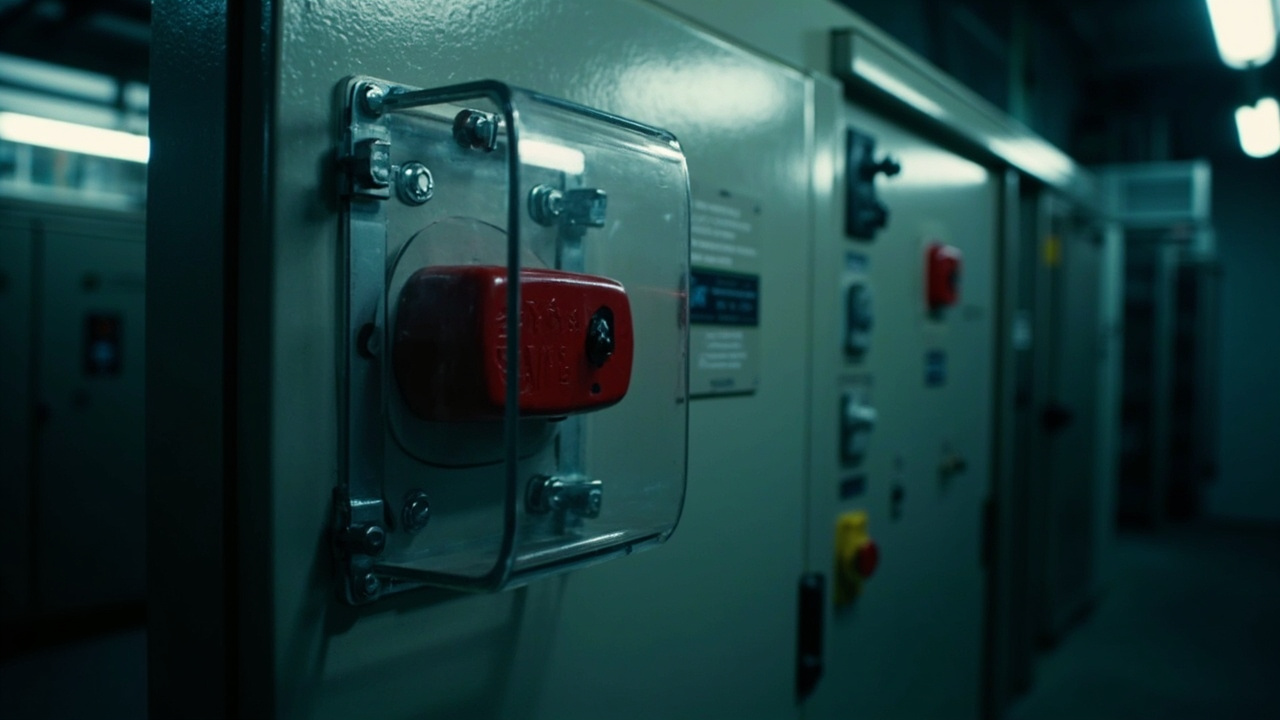
The term sounds like something from a sci-fi novel, but it is a real piece of engineering terminology with a specific meaning: a protective barrier designed to prevent accidental activation of a control. The name comes from Molly, a person at the University of Illinois, and the story of how her name became synonymous with accident-proofing is stranger than you would expect.
THE ORIGIN STORY
An alumni magazine of the University of Illinois, page 14, shows the actual Molly with her father. The story goes that Molly's father, an engineer, built a protective guard around a control panel after young Molly managed to shut down a mainframe by pressing buttons she was not supposed to touch. The guard was specifically designed to require intentional, two-handed operation—something a curious child could not easily accomplish. The term stuck, and for decades has been the engineering world's word for any barrier between a user and an accidental disaster.



Classic industrial molly guards survive in a museum in Germany, preserved as artifacts of early computing infrastructure. These are not subtle devices. They are physical barriers, often clear plastic or metal, that surround critical switches and require deliberate action to bypass. The design philosophy is simple: if it takes effort to hit the wrong button, you will not hit it by accident.
HARDWARE MOLLY GUARDS
The IBM electronic typewriter featured a perspex molly guard around its power button. The transparent shield meant you could see the button but could not reach it without consciously moving the guard out of the way. It was a clean solution that balanced visibility with protection, and it established a template that many manufacturers would follow.
Some machines took a softer approach. Rather than a physical barrier, they used quasi molly guards—raised bezels or flexible surrounds that made accidental pressing difficult without making intentional operation annoying. These are the tech equivalent of the bump on the F and J keys on a keyboard: they do not stop you from doing what you mean to do, but they make accidental contact much less likely.
Old floppy drives had handles that lowered the reading and writing head onto the disk surface. But the handle served a second purpose that qualifies it as a molly guard: once lowered, it physically blocked the mechanism that ejected the disk. You could not pull the disk out while the head was engaged, which meant you could not destroy your data by yanking the medium at the wrong moment. It was a mechanical molly guard, elegant in its simplicity.
The red light placement indicating an SD card was writing was intentional design to prevent damage from ejecting while writing. The LED sits where it is visible from most angles, and its steady glow during write operations is a visual molly guard—a reminder that the system is busy and the card should stay put. This is why ejecting a card while data is moving still triggers a warning in modern operating systems. The guard has moved from hardware to software, but the function is identical.
SOFTWARE MOLLY GUARDS
Finder has a molly guard that appears when pressing Command+O with many files selected. Instead of opening a dozen documents at once—likely crashing your machine or creating a chaos of windows—the system stops and asks what you actually wanted to do. It is a behavioral molly guard, protecting you not from hardware damage but from the chaos of your own intentions.
iPhone's persists as an exception for stopping the alarm. That familiar gesture is a molly guard hiding in plain sight: it prevents you from accidentally silencing a critical alert, requiring deliberate action to dismiss it. The gesture has been pared down in other contexts, but where it matters—where you might act without thinking—it remains.
Chrome has a molly guard for quitting the application. The guard requires holding Command+Q rather than just pressing it, with no feedback during the hold. You have to commit to closing the browser, holding the keys down for roughly a second while nothing happens. It is deliberately boring, deliberately uninformative, because the moment it gives you feedback is the moment it stops being a molly guard and becomes a timer. The designers understood that hesitation is the point.
Early iTunes had an extremely skeuomorphic CD burning molly guard. When you tried to burn a CD, the software would present a visual metaphor of an actual CD being inserted into a burner, with realistic shadows and lighting. The skeuomorphism was not just aesthetic—it was a cognitive pause, a moment where the interface said and forced you to acknowledge it before proceeding.
WHY ARE THEY STILL A THING?
Molly guards persist because human error is not a bug that gets fixed. We will always reach for the wrong button, double-click when we mean to single-click, or quit an application with twenty tabs open because our finger slipped. The guards do not make us less fallible; they make our fallibility less expensive.
The interesting thing about molly guards is that users often complain about them. The extra step feels unnecessary. The confirmation dialog is annoying. The hold-to-quit is slow. But the moment the guard is gone—and you accidentally eject a disk mid-write, or close a browser with hours of unsaved work—you instantly understand why it was there. Molly guards are the rare interface element that is loved in retrospect rather than in the moment.
THE COLLECTOR'S VIEW
The author of the original piece on molly guards has been collecting them since that first post went live. What started as a taxonomy of accidental-protection mechanisms became something like a naturalist's catalog: here is how different disciplines solved the same fundamental problem. The IBM typewriter guard and the Chrome hold-to-quit are solving the same puzzle with entirely different tools, and the range of solutions tells you something about how much human error costs across different contexts.



The collection is not comprehensive—new molly guards appear every time software designers decide that a particular action is dangerous enough to warrant friction. The latest crop lives in machine learning interfaces, where accidental deletion of a training set or a model checkpoint can set a project back weeks. The guards have evolved from perspex shields to confirmation dialogs to hold-to-confirm gestures, and they will continue evolving as the things we can accidentally break get more expensive.
what did you make of it?
more from science
science
IBM UNVEILS SUB 1NM CHIP WITH 100 BILLION TRANSISTORS
A new nanostack architecture doubles transistor density over the 2nm node, adding 10-15 years to the semiconductor roadmap.
science
ARXIVLABS OPENS PREPRINT SERVER FOR COLLABORATIONS
arXiv invites outside developers who share its values of openness, community, excellence, and privacy.
science
NOAA CONFIRMS El NINO IS HERE, COULD BE THE STRONGEST IN 140 YEARS
Oceans have absorbed 23 zettajoules of heat in recent years, the equivalent of 365 million atomic bombs. Now the climate system's best-known disruptor is loading…
science
SCIENTISTS DISCOVER OLDEST WHALE GRAVEYARD
A 2023 expedition found 476 fossilized whales and at least five active whale falls in the Diamantina fracture zone, some dating back 5.3 million years.