NASA'S DAPHNE MISSION TO STUDY SPACE WEATHER IMPACT ON EARTH
The twin-satellite mission, selected under a $250 million program, will launch as soon as 2029.
by editor6 min readcomments soon
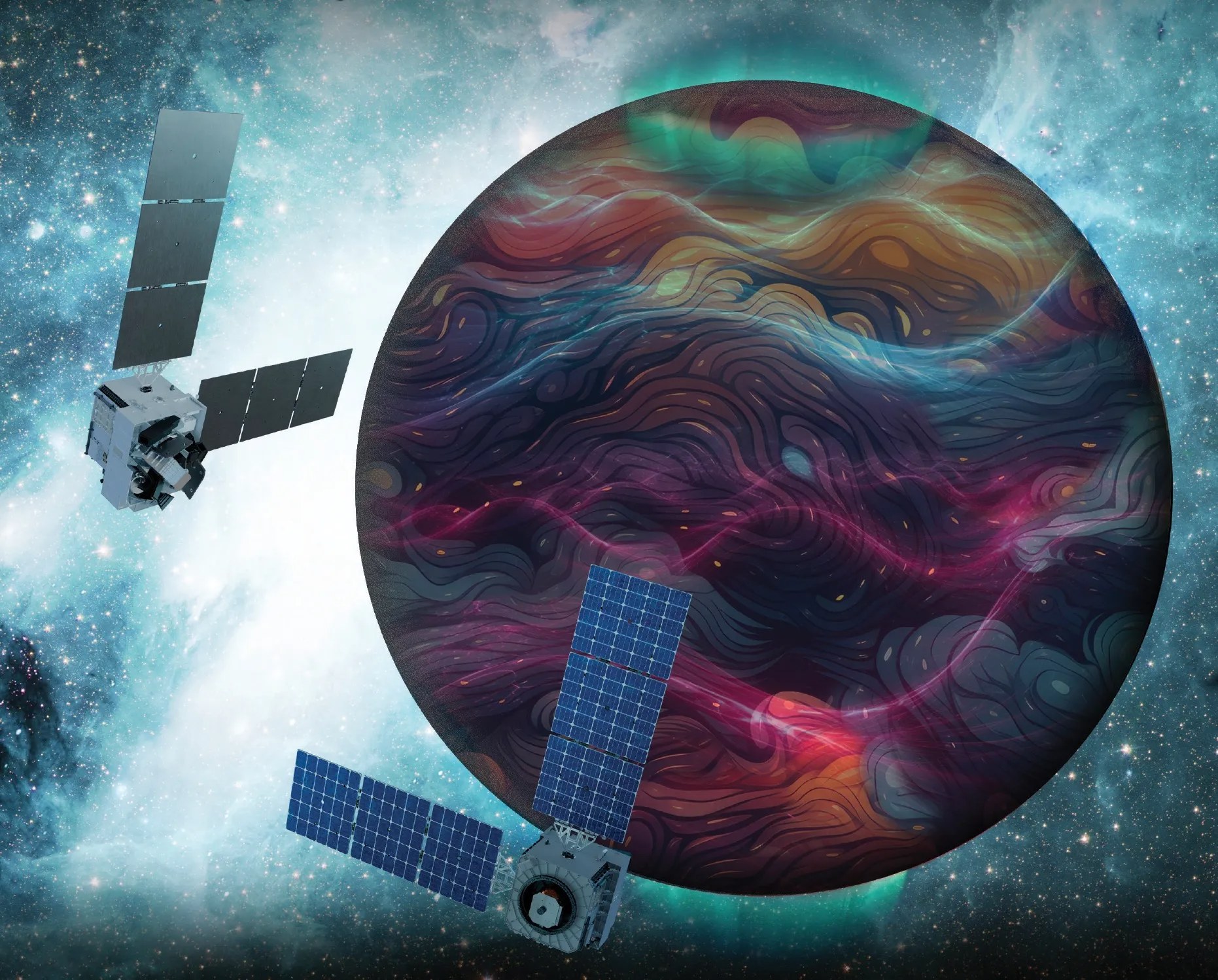
NASA has moved a space science mission called DAPHNE into the next development phase, with a target launch no earlier than 2029. The mission, formally the Dynamic Atmosphere-Ionosphere Explorer, will use two identical satellites to study one of the most persistent open questions in heliophysics: how weather in the lower atmosphere ripples upward and reshapes the ionosphere and thermosphere.
DAPHNE was one of three concepts selected in 2024 under a NASA program called DYNAMIC. The DYNAMIC program carries a cost cap of $250 million in fiscal year 2023 dollars, and NASA will not estimate DAPHNE's total cost until a confirmation review in 2027. The review will assess both the mission's technical progress and whether funding remains available.

WHAT WILL IT ACTUALLY MEASURE
The two satellites will fly in formation, gathering what the mission calls coordinated, multipoint measurements of neutral winds, temperature, and composition in the thermosphere. That is the band of atmosphere where energy from space weather events like solar flares and geomagnetic storms is deposited and dissipated. Right now, models of this region are coarse, partly because a single satellite cannot distinguish between a true spatial change and a change in time.
With two crafts, DAPHNE can separate those variables. Aimee Merkel of the Laboratory for Atmospheric and Space Physics at the University of Colorado Boulder, who leads the mission, said DAPHNE will fill a major gap in scientific understanding and help answer long-standing questions about how Earth interacts with our sun. "DAPHNE will fill this major gap in scientific understanding and help answer long-standing questions about how Earth interacts with our sun."
Each satellite will carry three instruments. The exact payload manifest has not been finalised, but the measurements will target neutral wind vectors, temperature profiles, and the composition of the neutral and ionised atmosphere. The real innovation is the orbital geometry: two identical platforms passing through the same region minutes or hours apart, giving researchers a stereoscopic view of a layer of the atmosphere that has been difficult to model accurately.
THE BIGGER SHIFT IN HELOPHYSICS
DAPHNE is arriving at a moment when NASA's heliophysics division is deliberately reorienting itself. Joe Westlake, the division director, has been clear that the agency wants more of its space weather research to produce outcomes that directly protect infrastructure and people. He described the division's trajectory as moving from curiosity-driven investigations to outcome-driven research.
Westlake framed the shift as a strategic question: Can we clearly articulate how this discovery will eventually protect our power grid, our GPS, or our astronauts? "Can we clearly articulate how this discovery will eventually protect our power grid, our GPS or our astronauts? Is the research applicable, or is it some niche science that only serves as a sort of single subdiscipline?" The alternative, he said, is niche science that only serves a single subdiscipline. The division is trying to drive research into a more strategic framework so that it can achieve the scientific outcomes asked for in the decadal survey. "Instead of having randomly spread research across our activities, trying to drive it into a more strategic framework so that we can achieve the scientific outcomes that were asked for in the decadal survey."
That language is not just bureaucratic repositioning. It reflects a real tension in the heliophysics community. For years, the field has produced elegant physics of the solar wind and the magnetosphere, but translating that physics into operational tools for satellite operators, power grid managers, and aviation authorities has been slow. The decadal survey process has pointed out that gap, and DAPHNE is one of the first missions designed with the translation gap in mind from the start.
Nicky Fox, associate administrator for NASA's Science Mission Directorate, made the applied case explicit in the selection announcement. She said NASA is advancing the United States' leadership as a space weather-ready nation, and by providing new insights into Earth's atmosphere, we can better predict and prepare for impacts in our daily lives on Earth and in space. "NASA is advancing the United States' leadership as a space weather-ready nation, and by providing new insights into Earth's atmosphere, we can better predict and prepare for impacts in our daily lives on Earth and in space."
THE HUMAN STAKES
The practical motivation is straightforward. Space weather events can disrupt power grids and interfere with GPS. Astronauts are also in the crosshairs. Beyond Earth's magnetic field, the radiation hazard from solar energetic particles spikes unpredictably. Fox noted that as NASA sends astronauts beyond Earth's magnetic protection to the moon, Mars and beyond, DAPHNE will join the NASA science fleet strategically located across the solar system to provide data that will help mission planners predict and mitigate the effects of space weather. "As NASA sends astronauts beyond Earth's magnetic protection to the moon, Mars and beyond, DAPHNE will join the NASA science fleet strategically located across the solar system to provide data that will help mission planners predict and mitigate the effects of space weather for the benefit of all."
The division's reorientation is partly about justifying the investment in basic plasma physics to a Congress and an administration that want to see a return. Westlake put it in broader terms: we have, as heliophysics, defined our community, but now we get to define what it means to everyone, what it means to society. "We have, as heliophysics, defined our community, but now we get to define what it means to everyone, what it means to society." That is a subtle but significant change. For decades, heliophysics could sell itself on the power of its questions. Now it has to sell itself on the power of its answers.
WHAT COMES NEXT
The confirmation review in 2027 is the next major milestone. That is when the mission gets a firm cost estimate in fiscal year 2023 dollars and a formal go-or-no-go decision. Between now and then, the team at LASP will refine the instrument design and settle the operational concept.
A town hall meeting about the mission was scheduled for May 20, an opportunity for the broader scientific community to ask questions about the selection and the development timeline. The meeting is the kind of open process that NASA uses to catch assumptions that could cause trouble later.


For now, DAPHNE is a mission that passed one gate. The next three years will determine whether it clears the rest.
what did you make of it?
more from space
space
SPACEX ABORTS STARTSHIP FLIGTH 13 AFTER ENGINES FAIL TO IGNITE
An automatic abort kicked in when some Raptor engines on the Super Heavy booster didn't light; two engines will be replaced before the next try.
space
FFC APPROVES SPACE MIRROR: REAL ISSUE IS THE OTHER MILLION SATELLITES
Reflect Orbital gets a license to test sunlight reflection, while SpaceX files for 40 times as many satellites as have ever been launched.
space
ISPACE BUYS 500KG OF PAYLOAD SPACE ON LUNAR LANDER STARSHIP
The Japanese firm will develop a rover to deliver customer payloads up to a few kilometers across the lunar surface, targeting a 2030 launch.
space
ASTRONOMERS SAY 1.7MN SATELLITES WOULD DESTROY GROUND BASED ASTRONOMY
A new ESO study calculates that proposed megaconstellations would make large telescope images unusable for hours each night.