JAMES WEBB TELESCOPE MAY HAVE SOLVE THE MYSTERY OF THE LITTLE RED DOTS
A deep JWST spectrum of one oddball object suggests — rapidly feeding supermassive black holes shrouded in dense gas — are behind the bizarre red objects that populate the early universe and then vanish.
by editor4 min readcomments soon
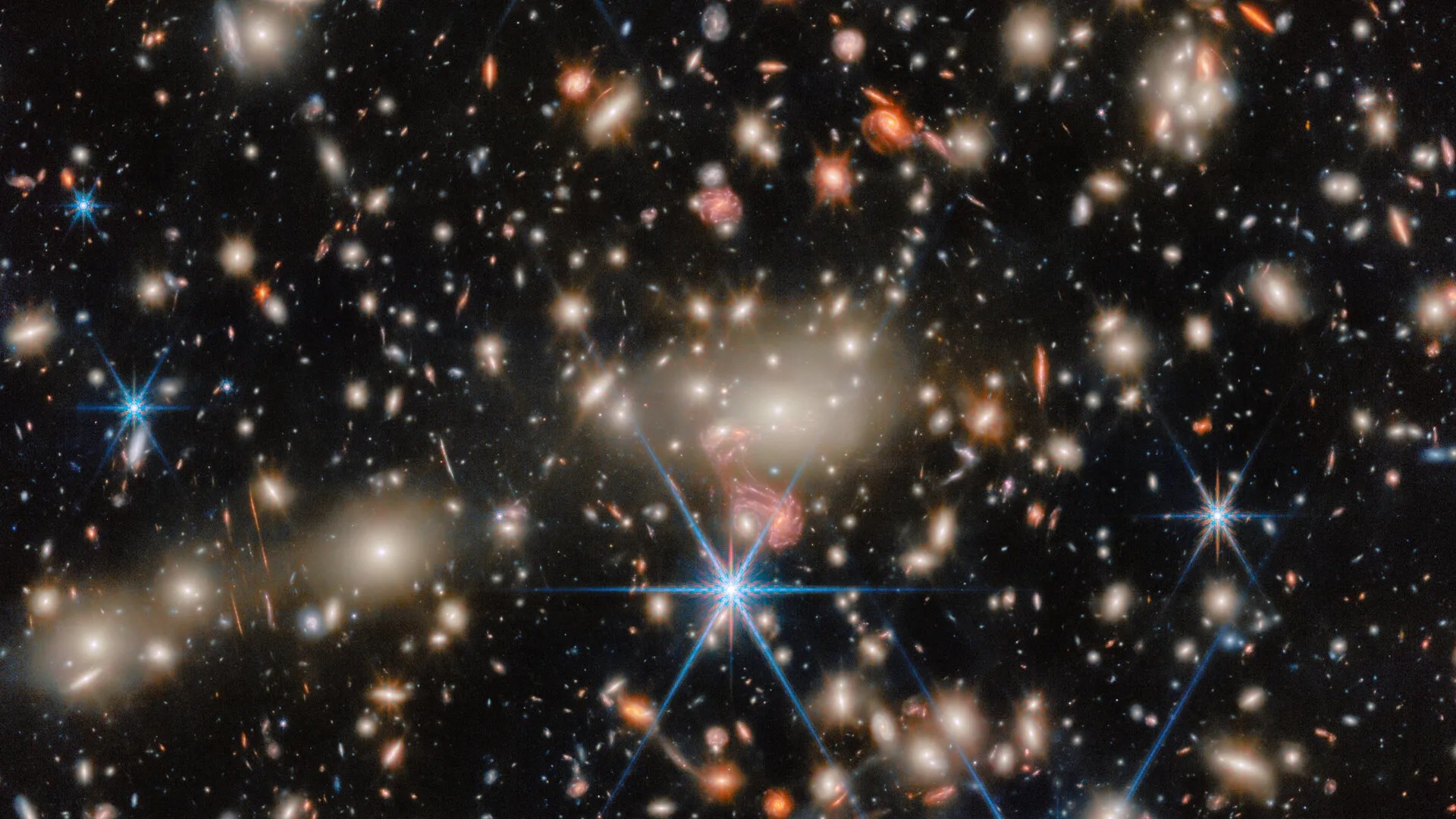
When the James Webb Space Telescope began returning data in the summer of 2022, astronomers noticed something strange: thousands of tiny, impossibly red points of light scattered across the early universe, appearing around 600 million years after the Big Bang and then mysteriously vanishing before the cosmos reached 2 billion years old. For two years, little red dots remained an open question — compact, extremely red objects that did not behave like normal galaxies and did not fit any existing model of early cosmic structure.
Now, a team using JWST may have the answer.

THE DEEPEST LOOK YET
The astronomers targeted one of these objects, designated GLIMPSE-17775, located 1.8 billion years after the Big Bang. They observed it while studying the gravitational lens galaxy cluster Abell S1063, whose massive gravitational influence warps spacetime and magnifies background objects. The gravitational lensing turned 30 hours of observing time into the equivalent of about 80 hours, producing the deepest spectrum of any little red dot collected to date.
The spectrum revealed more than 40 spectral lines, including hydrogen, oxygen, and helium, along with 16 iron lines that the team dubbed an The emission lines did not fit a simple model of a rotating gas cloud. Instead, the best-fit model required electron scattering, consistent with a radiation source enshrouded by dense gas. "When we saw the spectrum for the first time, it was like having all the pieces of a puzzle scattered on the floor"
said Vasily Kokorev at the University of Texas at Austin.
THE BLACK HOLE STAR MODEL
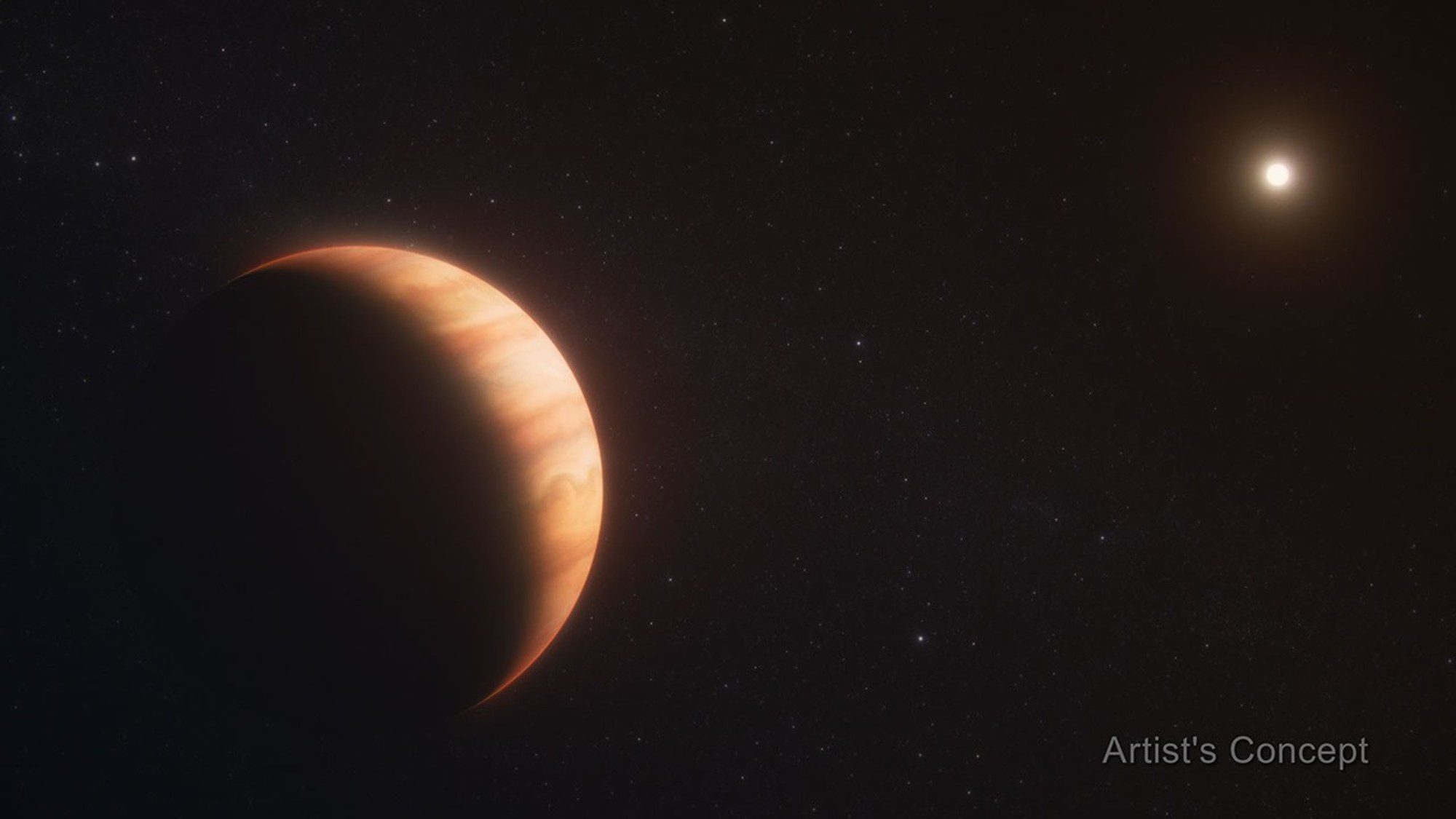
The leading explanation for little red dots is the black hole star scenario. In this model, these objects are rapidly accreting supermassive black holes wrapped in a dense cocoon of partially ionized gas. The intense, short-lived growth spurts would cause them to burn bright red, then fade as the feeding frenzy ends — which would naturally explain why they disappear from view by the time the universe is about 2 billion years old.
The iron forest detected in GLIMPSE-17775 is exactly what would be expected from the high-energy output of a rapidly feeding supermassive black hole. The dense gas shroud would also explain why little red dots are typically faint in X-rays: the thick envelope blocks X-ray emission while allowing longer wavelengths to pass through.
The team also noted that GLIMPSE-17775 has a weaker Balmer Break than typical little red dots, a feature they attribute to the object being surrounded by a massive host galaxy. The black hole star model attributes any excess blue light to stars in this host galaxy.
Kokorev said. "I think part of the scientific community is converging on a singular picture — that little red dots can be explained by black hole star models. But none of the previous little red dots have all of the pieces of evidence in the same place"
WHY THIS MATTERS
The research, published June 10 in The Astrophysical Journal, represents the most comprehensive spectroscopic evidence yet for the black hole star hypothesis. It ties together multiple observed properties of little red dots — their red color, their rapid disappearance, their faintness in X-rays, and their spectral signatures — into a single coherent framework.
The team was actually searching for Population III stars, the hypothesized first generation of stars formed from pristine hydrogen and helium, when they stumbled upon GLIMPSE-17775 behind Abell S1063. Gravitational lensing, first predicted by Albert Einstein in his theory of general relativity, made the faint object detectable at all.
Kokorev said. "Looking ahead, I'm eager to dive deeper and learn about what is powering the central engines of little red dots. While we think it's a black hole, there are some other interesting theories being proposed, which is exciting. Maybe in a year or two, we'll have the final answer to what powers these sources"


For now, the puzzle appears to be coming together. Kokorev said. "Everything fits, nothing is broken, and I think that makes the puzzle that is our universe even better"
what did you make of it?
more from space
space
SPACEX ABORTS STARTSHIP FLIGTH 13 AFTER ENGINES FAIL TO IGNITE
An automatic abort kicked in when some Raptor engines on the Super Heavy booster didn't light; two engines will be replaced before the next try.
space
FFC APPROVES SPACE MIRROR: REAL ISSUE IS THE OTHER MILLION SATELLITES
Reflect Orbital gets a license to test sunlight reflection, while SpaceX files for 40 times as many satellites as have ever been launched.
space
ISPACE BUYS 500KG OF PAYLOAD SPACE ON LUNAR LANDER STARSHIP
The Japanese firm will develop a rover to deliver customer payloads up to a few kilometers across the lunar surface, targeting a 2030 launch.
space
ASTRONOMERS SAY 1.7MN SATELLITES WOULD DESTROY GROUND BASED ASTRONOMY
A new ESO study calculates that proposed megaconstellations would make large telescope images unusable for hours each night.