NASA'S ERNEST ROVER COVERS 16 MILES IN DESERT DESERT, 10X FASTER
The prototype four-wheel rover logged 37 hours of drive time in the Colorado Desert, a speed benchmark for future lunar missions.
by editor5 min readcomments soon
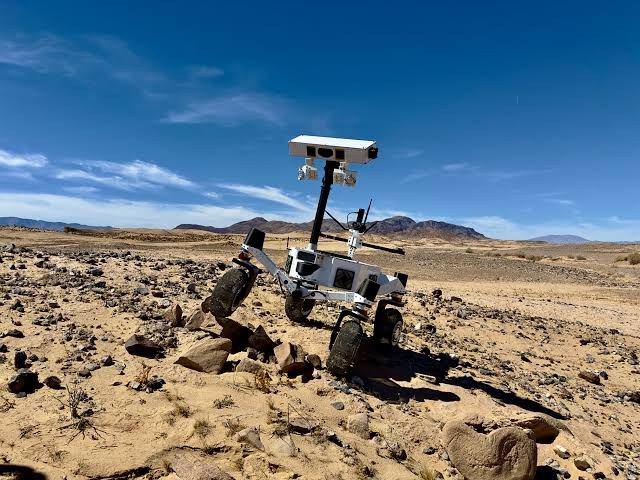
A prototype rover just did something that would be a milestone for planetary exploration. It covered 16 miles of rough terrain in 37 hours, more than ten times the speed at which NASA's Perseverance rover can navigate on Mars.
The rover is called ERNEST, short for Exploration Rover for Navigating Extreme Sloped Terrain. It is a prototype developed at NASA's Jet Propulsion Laboratory in Pasadena, California, which is managed by Caltech. In March 2026, a team took the four-wheel machine out to the Colorado Desert near Plaster City, California, and ran it through its paces. The goal was not just to see how far it could go, but to test autonomy software designed for a future lunar mission that would require far higher speeds and greater mileage than anything JPL has flown before.
THE TEST THAT MATTERS
The 16-mile traverse is the headline statistic, but what it represents is more important. Current Mars rovers like Perseverance drive at a cautious crawl, stopping frequently to assess the terrain with onboard cameras and wait for instructions from Earth. That works for a stationary science platform on a planet where a round-trip radio delay is several minutes. For the Moon, where the delay is only a couple of seconds but the terrain is steep, shadowed, and unforgiving, a rover that never breaks out of a gentle jog is not going to cover the distances needed for high-priority science.
ERNEST's test drove continuously over rocky desert terrain, relying on its autonomy software to pick paths, avoid obstacles, and keep moving without a human in the loop. The team followed in chase vehicles, monitoring the rover as it covered ground more efficiently than any previous JPL prototype. The 16 miles, accumulated over 37 hours, is a benchmark that directly scales to what a lunar mission might demand.
WHY THE SPEED GAP MATTERS
ERNEST averaged about 0.43 miles per hour across its 37-hour run, and that number is misleading because it includes stops for testing and observation. The peak sustained speed was higher. The point is that the autonomy stack works at a velocity that changes the mission calculus. A rover that can cover several kilometres per day, rather than a few hundred meters, opens up targets that were previously out of reach: crater rims, lava tubes, polar deposits, the types of features that the next generation of lunar science objectives targets.
DAY, NIGHT AND DAWN
The team did not stop at daylight driving. They ran ERNEST at dusk, dawn, and through the night, simulating the long, low-angle shadows found in the Moon's polar regions. The lunar poles have permanently shadowed craters where sunlight never reaches, and any rover exploring there will spend a lot of time operating in near-total darkness. ERNEST's test at night tested how its sensors and autonomy software handled those conditions, with team members setting up illuminators on the rover to replicate the way a real mission might use headlights or floodlights. The results are not broken out in the public data, but the fact that the test included night runs at all tells you that JPL is serious about a polar mission.
FROM INTERNAL EXPERIMENT TO PROGRAM
ERNEST started as a skunkworks project in 2022, funded by JPL's internal research and development dollars. That is how a lot of NASA's best prototypes are born: an engineer with an idea, a small pot of money, and a mandate to prove the concept before the agency commits to a formal program. By 2026, the project had attracted funding from two separate NASA offices: the Mars Exploration Program and the Exploration Science Strategy Integration Office under the Science Mission Directorate in Washington. That shift from internal experiment to program-funded is a strong signal that the agency sees ERNEST's autonomy capabilities as relevant to both Mars and the Moon.
The dual funding is telling. The Mars program is interested because faster traverse speeds would let a future rover reach multiple science targets in a single mission, increasing the return on investment. The Exploration Science office is interested because the same autonomy could support the human-exploration infrastructure planned for the lunar south pole, where crews will need robotic scouts to survey landing zones and resources before astronauts arrive.
WHAT THIS ACTUALLY PROVES
A single field test does not prove that the autonomy software is ready for a planetary mission. It proves that the software works on Earth, on terrain that is an analogue for the Moon but not an exact match. The next step is to prove that the system can handle the thermal, radiation, and vacuum environments of space, and that it can survive the landing loads that would precede any traverse. Those are hard problems, but they are engineering problems. The core autonomy question, can the rover drive itself over unknown ground at useful speeds without getting stuck or crashing, appears to have been answered.
The team observed the rover with a wheel up on a rock during one of the test runs, a reminder that even advanced autonomy occasionally needs to drive over obstacles rather than around them. That is fine. The test's success is measured in miles, not perfection.
FASTER DATA FROM SPACE
The funding from both the Mars and lunar exploration offices suggests that the technology is being positioned as a candidate for whatever comes next: a Mars sample return campaign that needs a faster fetch rover, or a lunar south pole science mission that needs to cover a hundred kilometres across multiple days.


For now, the 16-mile desert run is the data point that matters. Planetary rovers have crept for fifty years. ERNEST showed that they can finally move.
what did you make of it?
more from space
space
SPACEX ABORTS STARTSHIP FLIGTH 13 AFTER ENGINES FAIL TO IGNITE
An automatic abort kicked in when some Raptor engines on the Super Heavy booster didn't light; two engines will be replaced before the next try.
space
FFC APPROVES SPACE MIRROR: REAL ISSUE IS THE OTHER MILLION SATELLITES
Reflect Orbital gets a license to test sunlight reflection, while SpaceX files for 40 times as many satellites as have ever been launched.
space
ISPACE BUYS 500KG OF PAYLOAD SPACE ON LUNAR LANDER STARSHIP
The Japanese firm will develop a rover to deliver customer payloads up to a few kilometers across the lunar surface, targeting a 2030 launch.
space
ASTRONOMERS SAY 1.7MN SATELLITES WOULD DESTROY GROUND BASED ASTRONOMY
A new ESO study calculates that proposed megaconstellations would make large telescope images unusable for hours each night.