NUCLEAR IS BACK IN EUROPE AND AI IS THE REASON
Deal volumes just hit a seven-year high, governments are killing phase-out laws, and the SMR pipeline is finally taking shape.
by editor5 min readcomments soon
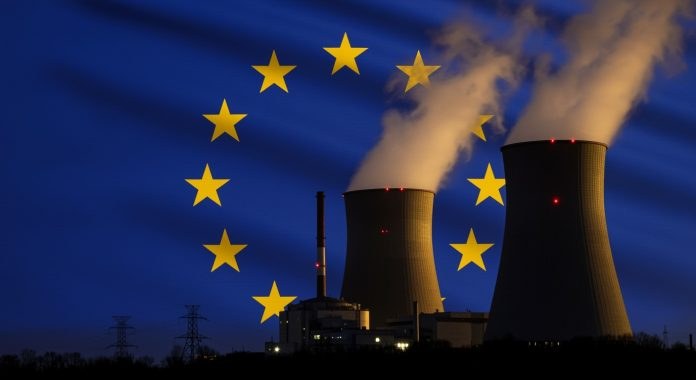
Nuclear power is having a moment in Europe, and the deal data backs it up. A total of 25 transactions closed in 2025, up from 17 a year earlier, and total deal value hit $1.5 billion, the highest mark in seven years. The numbers keep accelerating: by June 8 of this year, ten more deals totalling $3 billion had already been announced, effectively doubling 2025's full-year output in less than six months.
The numbers reflect a structural shift, not a temporary spike. After more than a decade of phase-outs, expensive overruns, and public scepticism, Europe is betting on nuclear again. The bet is driven by the one thing that keeps growing regardless of politics: demand for electricity that never stops, from data centres running AI models.
WHY NOW? THE ENERGY PROBLEM
AI data centres consume huge amounts of baseload power, around the clock. Wind and solar cannot provide that alone without massive storage or backup from fossil fuels. Nuclear can. It is the only zero-carbon energy source that delivers 24/7 output on its own terms. Operators have started to make that connection.
Public support for nuclear has rebounded in the AI era. The logic is hard to argue with: if the grid needs to double in size to support the compute clusters training the next generation of large language models, and if decarbonization targets are non-negotiable, then atomic power becomes less of a political choice and more of a mathematical one.
THE GOVERNMENT STAMPEDE
The European Commission is putting money behind the shift. It is investing €330 million through the 2026–2027 Euratom Research and Training Programme, with the lion's share (€222 million) dedicated to pushing nuclear fusion from the lab toward commercial electricity production. That is a long-term play, but fusion hardware does not help the grid tomorrow.
The near-term push revolves around small modular reactors. The European Industrial Alliance on Small Modular Reactors now includes over 350 stakeholders and has endorsed a five-year roadmap outlining targeted actions. The EU's current nuclear capacity stands at 112 GW; SMRs are projected to add up to 53 GW by 2050.
Nation-level activity is accelerating even faster. The UK selected North Wales as the site for its first SMR, backed by a £2.5 billion investment. Rolls-Royce SMR, chosen by Great British Energy (Nuclear) as the preferred technology partner in 2025, has signed multibillion-pound agreements to build reactors in Sweden. The UK government also accepted applications to begin the Generic Design Assessment for advanced reactors, including TerraPower's Natrium design.
Belgium, long the poster child for nuclear phase-out, has abandoned the policy altogether. The federal parliament voted to repeal the 2003 phase-out law, suspending decommissioning and extending the operational lives of Doel 4 and Tihange 3 to 2035, with an aim to get another ten years beyond that. The government has initiated negotiations to take full control of the country's seven nuclear reactors from the French energy giant Engie.
Italy is advancing legislation and drafting framework laws to bring nuclear energy back. Switzerland's Senate and House of Representatives have both voted to lift the ban on constructing new nuclear plants.
HARDWARE GAP
For all the deal flow and policy energy, the technology that everyone is counting on has not yet arrived on electric grids. Small modular reactors have tantalised hyperscalers and governments hoping to win the AI race, but no SMR is producing commercial power in Europe today. The roadmaps all point toward demonstration and deployment around 2030, but project schedules in the nuclear world have a history of slipping.
That gap matters because the AI buildout is happening now. Data centre operators buying power purchase agreements today cannot wait for a regulatory framework to mature and a factory to spin up its first SMR. The revival, therefore, has two timelines: the near term, where existing large reactors are being extended or brought back online, and the longer term, where SMRs (and eventually fusion) are supposed to scale.
WHO IS BETTING AND HOW MUCH
The public-market side of the revival showed up in the Deep Fission IPO. The company opened at $16 a share on its Nasdaq debut, a signal that investors are willing to put money behind novel reactor designs even before they produce power.
The corporate landscape is shifting, too. Beyond Rolls-Royce and TerraPower, established players like EDF are competing with next-generation designs such as Nuward. The BWRX-300, a GE-Hitachi design, is being evaluated for multiple European sites. The competition is healthy, but it also means the eventual winners are not yet clear.
THE BLUNT INSTRUMENT
The fusion allocation inside the Euratom program is notable. Fusion offers essentially unlimited clean energy with zero long-lived waste, but commercial fusion has been thirty years away for sixty years. The €222 million is a research investment, more than a deployment subsidy.
MONEY IS MOVING
Three things matter in the near term. First, whether the 2026 deal pipeline continues at the current pace. The first half of the year already doubled last year's value, but nuclear transactions are lumpy, and one megadeal can distort the curve. Second, whether any European SMR actually breaks ground and hits a construction timeline. That would transform the conversation from policy enthusiasm to physical reality. Third, whether the public backlash that killed the previous wave of nuclear expansion has truly receded, or whether the current support is a temporary bubble inflated by AI panic that will pop when the first cost overruns make headlines.
For now, the money is moving, the laws are changing, and the reactors are being kept alive. Europe is rebuilding a nuclear industry it spent the last twenty years dismantling. That is not a pivot; it is a reversal.
what did you make of it?
more from climate & energy
climate & energy
CANADIAN WILDFIRE TURNS US SKIES YELLOW AS 800 FIRES RAGE ON
New York City hit an AQI of 200, and the Twin Cities were rated “hazardous” as winds carried smoke from over 800 Canadian wildfires southeast.
climate & energy
EU GAS PRICES SKYROCKET AS QATAR HALTS ALL MARITIME ACTIVITY
The Dutch TTF futures jumped 3.35% after a weekend of renewed U.S.-Iran hostilities and the first blanket shipping suspension by a Gulf state.
climate & energy
CALIFORNIA SETS NEW EV INCENTIVES, REWARDS LOCAL MAKERS AND SNUBS TESLA
A $135M program waives price caps for Rivian and Lucid while Tesla, which moved its HQ to Texas, gets no such break.
climate & energy
OPEC+ HIKES OUTPUT AGAIN AS FRAGILE PEACE RESHAPES OIL MARKET
The UAE quit, the Strait of Hormuz is reopening, and retail traders will soon place 10-barrel bets around the clock.