STABLE ANDROID 17 IS FINALLY HERE
Google’s latest version is described as a refinement, not a major redesign, after an extended beta period.
by editor5 min readcomments soon
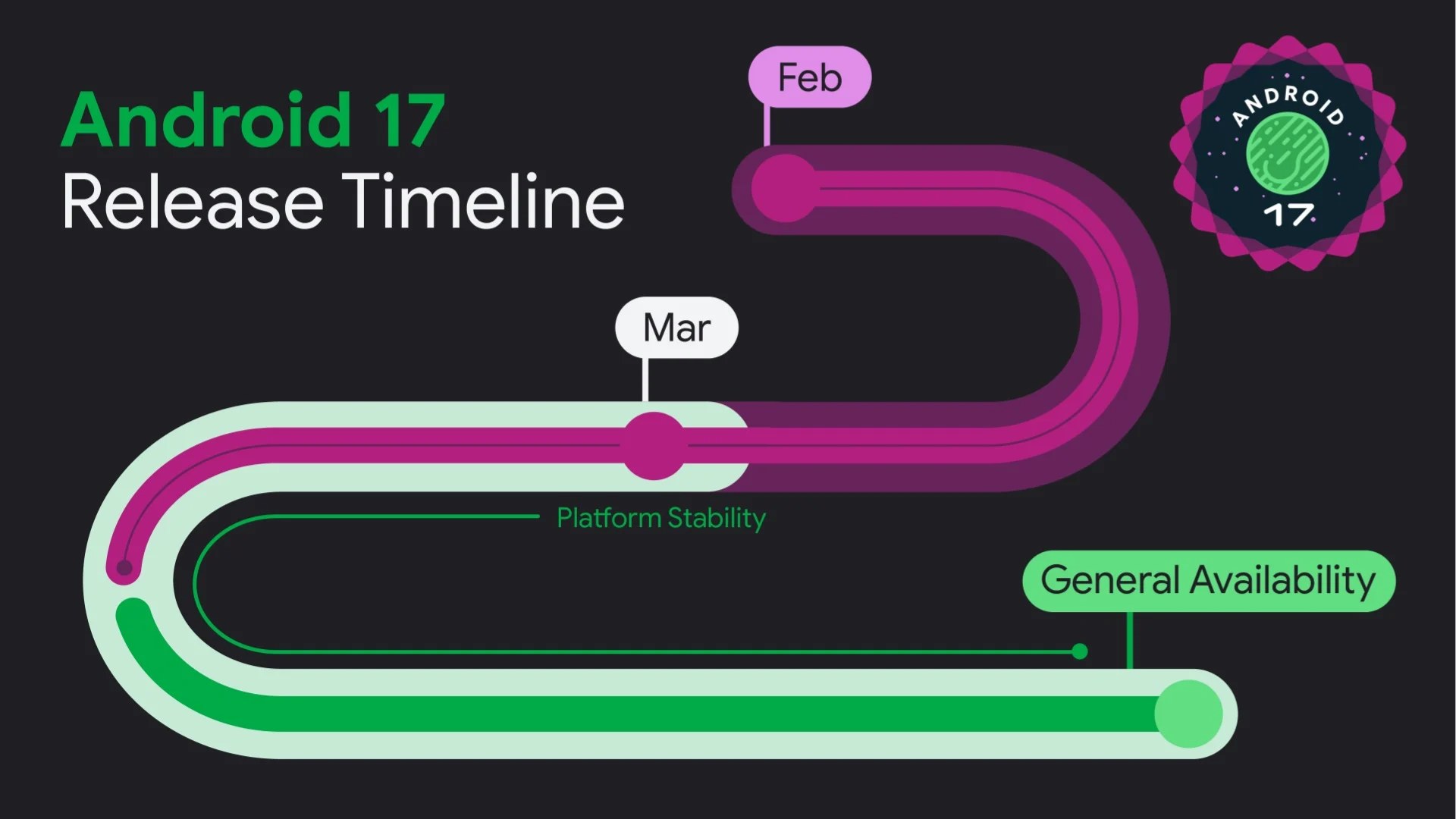
Google has finally released the stable Android 17 update today after more than three months of in-public testing. By the company’s own self-described framing in the information available, this is not a massive redesign of the operating system. It is an incremental version aimed at polish and reliability rather than first-sight headlines.
That framing matters because Android 17 is releasing into an environment where major changes are often what draw attention. A version described as not a redesign means the visual language, core navigation, and system behavior will feel familiar to anyone running Android 16. The upgrade path should be as frictionless as Google can make it, which is precisely the point.
THE NUMBERS THAT AREN'T THERE
The fact set for this release contains no specific feature list, no performance benchmarks, no battery life claims. What we have instead is a release date, a testing duration, and an explicit admission that this is not a splashy overhaul. That absence of a feature sheet tells its own story. Google chose to lead with schedule and stability rather than a set of bullet-point innovations. For a company that has occasionally been accused of overloading Android updates with chrome, that silence is itself a signal.
A three-month beta period is longer than some of Google’s previous Android preview cycles. The extra time suggests the team was running a disciplined validation pass. Companies ship stable releases after beta windows of varying length, often tied to hardware launch deadlines or internal roadmaps. Three months of testing implies Google wanted to feel confident that the known edge cases were exercised before flipping the stable switch.
WHAT 'NOT A MASSIVE REDESIGN' REALLY MEANS
The claim that Android 17 is not a massive redesign sets expectations for the entire ecosystem. Google essentially says: if you were expecting Android to look or behave fundamentally differently, this is not that version. That is a useful contract with both users and developers. New device makers can expect they don’t need to rewrite their custom skins. App developers can expect the API surface to be largely backward-compatible. Users can expect they won’t have to relearn basic gestures.
The absence of a redesign does not mean the code is unchanged under the hood. Under the hood improvements are often the work that carries a platform forward without disrupting muscle memory. The fact set does not list those improvements, but the pattern from prior analogous releases is that they exist. The stable tag means those changes have proven themselves over the beta run.
THE TESTING PHASE
Google spent more than three months testing Android 17 across a range of devices before calling it stable. That testing isn’t just about bug reports. It is about validating compatibility and reliability across a wide range of hardware and carriers. The Android beta program lets thousands of users run pre-release code on production phones, which produces a diagnostic signal that a closed lab cannot match.
A stable release after a multi-month beta is the moment Google stops saying “we think this is ready” and starts saying “we know this is ready.” For users who participated in the beta and stayed on it, today’s release means they can move to the final build without a full wipe. For everyone else, it means the update is available over the air, assuming their device maker supports it.
WHY THE APPROACH IS WORKING? KINDA?
Android’s upgrade fragmentation has been a long-running industry conversation. Every time a major redesign ships, device makers face a months-long porting process before they can deliver it to their customers. An incremental release shortens that cycle. If Android 17 is genuinely a refined version of what came before, the time between Google’s source drop and a user receiving the OTA should be shorter on average than after a redesign.
The fact that this is not a massive redesign also protects the upgrade path for devices that were not originally slated to receive it. A lighter delta update is easier to backport to older hardware than a heavy one. That matters for many phones still running older versions that could pick up the update’s benefits without needing a full revamp of their system images.
WHAT WE SHOULD ALL BE LOOKING OUT FOR
The release of a stable build is not the end of the story. Now the machine gears of the Android ecosystem turn: the source code hits the Android Open Source Project, third-party ROM developers start their own builds, and device manufacturers begin certification for their own hardware. The timing of Google’s own Pixel line updates is usually immediate or near-immediate. Other OEMs may take weeks or months.
The longer-term question is whether the pattern set by Android 17 becomes a template: spend three months in beta, ship a stable build that explicitly forgoes a redesign, and rely on under-the-hood changes to carry the update. If that cadence works for security and stability, Google could decouple the version number from the visibility of changes, making version increments a matter of internal plumbing rather than marketing.

For now, users who update can expect a system that behaves the way it did before but with fewer surprises. The story of Android 17 is not one of new capabilities. It is the story of a platform team saying, “We spent the last quarter making sure this thing is solid, and here it is.” That is not the flashiest headline, but for the people actually using the operating system, it may be the most important one.
what did you make of it?
more from consumer tech
consumer tech
GOOGLE ADDS YOUTUBE MUSIC, INSTACART & CANVA TO AI MODE SEARCH
Starting this week, US users can ask AI Mode to make a playlist, fill a grocery cart, or design a flyer without leaving the search…
consumer tech
ONEPLUS DEAD IN THE WEST, OPPO OVERLORDS PULL PLUG
The brand that built its reputation on has settled for leaving its biggest markets. Existing phones still work. New ones won't come.
consumer tech
GOOGLE PIXEL 10 PRO DROPS TO 699, BEST DEAL YET!
A $300 discount on the 128GB model undercuts Prime Day pricing and signals a clear runway to the pixel 11 launch.
consumer tech
APPLE RAISES APPLE ON BUNDLE FOR FAMILY AND PERMIER PLANS
the Family plan jumps $2 to $27.95 a month and the Premier to $39.95; Apple hasn’t explained the bundle increase beyond citing music licensing for…