NVIDIA'S KYBER AI RACK DELAYED TO 2028!
The NVL144 rack slips more than a year, a four-die Rubin Ultra chip is axed, and Asian suppliers get hammered.
by editor5 min readcomments soon
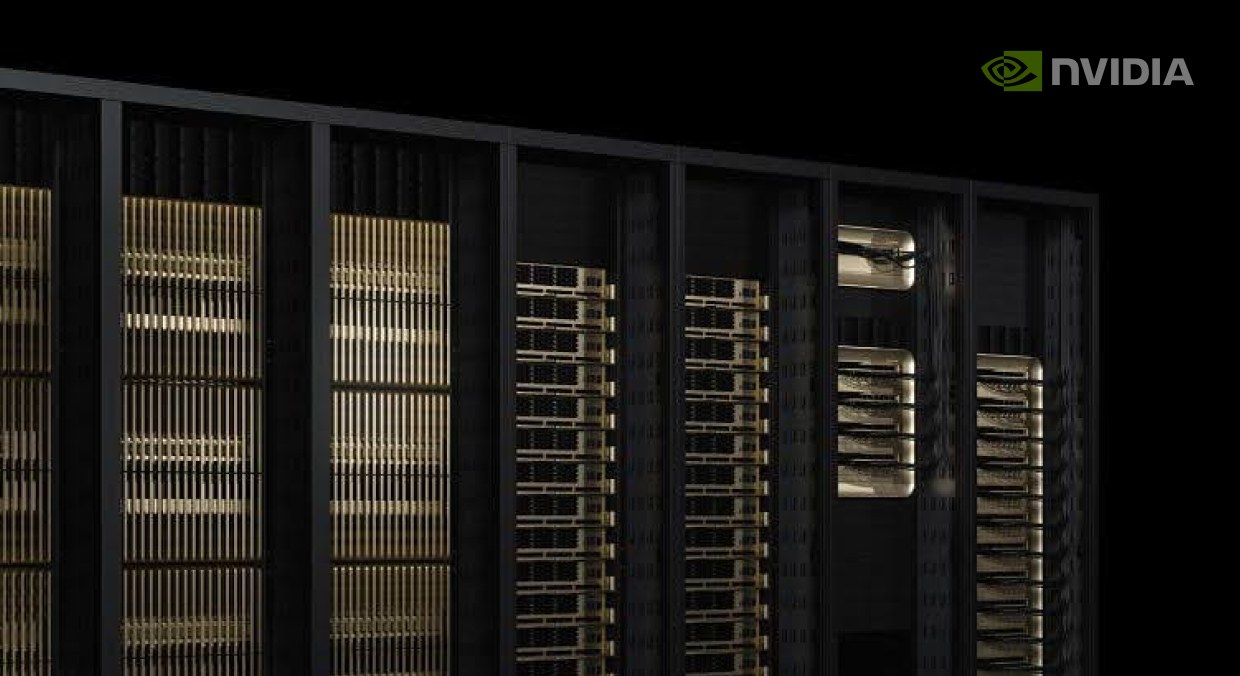
Nvidia's next big AI server rack is late. The Kyber NVL144, the follow-on to the current Oberon-based systems, has been pushed back by more than 12 months and won't ship until 2028. Analyst firm SemiAnalysis first reported the delay on X, and the news sent a shock through Asian tech suppliers from Japan to Hong Kong.
The problem is not the chips themselves but the circuit boards that connect them. Specifically, the PCB midplane inside the Kyber rack has proven extremely difficult to manufacture without defects. SemiAnalysis cited PCB midplane problems as the core bottleneck. A stopgap solution for the Kyber rack was also scrapped after customers pushed back.


THE KYBER DELAY
Nvidia CEO Jensen Huang showed off the Kyber NVL144 at the GTC conference only three months ago. Now it is more than a year behind schedule. The rack was supposed to be the next step in Nvidia's relentless cadence of doubling AI performance per generation. Instead, it becomes a reminder that even the most aggressive roadmaps can hit physical limits.
A separate alternative design, the NVL72x2, has been cancelled entirely. That rack was also meant to bridge the gap between current Oberon systems and the full Kyber architecture, but cloud customers pushed back against its unusual form factor and high operational overhead. No stopgap remains.
PCB MIDPLANE, A.K.A THE WEAK LINK
The midplane is the large circuit board that sits between the compute nodes and the switching fabric in a dense rack. In Nvidia's designs,gns it carries thousands of high-speed signal traces, power delivery, and thermal management channels, all packed into a form factor that has to mate with dozens of modules. Producing such a board without shorts, opens, or impedance mismatches is not trivial. Nvidia's Kyber design apparently pushes that difficulty past what current manufacturing yields can sustain.
The result is a delay that cascades. Without the Kyber rack, Nvidia cannot ship its highest-density AI server configuration, and that limits the scale at which hyperscalers can deploy the next generation of GPUs.
SUPPLIER BLEED
The market reaction was brutal. Japanese PCB maker Ibiden, which counts Nvidia as its largest customer, dropped as much as per cent. Kingboard Laminates fell 18 per cent in Hong Kong. Elite Material lo20 per cent in Taiwan. Samsung Electro-Mechanics slid 18 per cent in South Korea, even after gaining more than per cent this year. The selloff was broad: suppliers across Japan, Taiwan, South Korea, and Hong Kong saw sharp declines.
The scale of the drops reflects how tightly Nvidia's roadmap is tied to the fortunes of its supply chain. Anyone betting on a smooth ramp through 2026 and 2027 got a reminder that silicon is only half the story. The other half is the board, the cooling, and the power delivery that make the silicon useful.
A SLOWER ROADMAP
The Kyber delay is not the only setback. The more powerful version of the Rubin Ultra chip, the one with four compute dies, has been cancelled. Only the smaller two-die version of Rubin Ultra remains. Real-world compute performance is roughly half of what the four-die design would have delivered. Nvidia lacks a proven way to scale Rubin Ultra to very large systems for now.
The interconnect technology CPO-NVSwitch, which was supposed to tie together racks at photonic speeds, won't arrive until the generation after Rubin, a design called Feynman. That means Nvidia's ability to build the massive clusters that power the largest AI training runs is constrained, possibly for multiple years.
WHAT IT MEANS FOR COMPETITORS
Every gap in Nvidia's roadmap is an opportunity for someone else. AMD's MI500X and Google's TPUv8i Broadfly are both in the pipeline, and both are aimed squarely at the hyperscale workloads that Nvidia's Kyber rack was supposed to serve. If cloud providers can't get the density they want from Nvidia, they may look harder at alternatives.
Shawn Oh of NH Investment & Securities pointed to growing uncertainty around Nvidia's expansion plans, which gives alternative AI platforms more room to compete. The uncertainty is real: the next-generation rack is late, the high-end chip is dead, and the interconnect that ties everything together is two generations away.
THE MARKET PERSPECTIVE
Not everyone thinks the delay signals a structural slowdown in AI spending. Gary Tan of Allspring Global Investments said a Kyber delay does not necessarily mean overall AI spending will shrink. He argued that the current stock weakness is mostly driven by profit-taking after the massive run-ups in supplier stocks this year. Kingboard Laminates was up 470 per cent year to date before the drop. Samsung Electro-Mechanics was up more than 600 per cent. A pullback was overdue.
Nvidia plans to make up for the shortfall by selling more Oberon-Rubin racks in the existing form factor. Those racks are proven, shipping, and still competitive. But selling more of what you already have is not the same as delivering the next thing on time. The market wants to see the roadmap hold. Right now, it doesn't.
WHAT COMES NEXT
The Kyber delay matters most for the customers who have already committed to Nvidia's roadmap. Those customers are now looking at 2028 before the next density jump arrives. In AI hardware, two years is an eternity. If AMD or Google can ship a competitive alternative in that window, the competitive dynamics of the AI data centre could shift.

For Nvidia, the headache is real but contained. The company still owns the market, still has the best software stack, and still prints money. But the narrative that Nvidia never stumbles is taking a hit. Circuit boards are not supposed to be the bottleneck.
what did you make of it?
more from ai
ai
TSMC ADDS $100 BILLION TO ARIZONA CHIP BET, TOTAL HITS $265 BILLION
The additional investment will build at least four more 2nm fabs and advanced packaging, bringing the company's total US commitment to $265 billion.
ai
META WILL ALERT PARENTS IF TEENS DISCUSS SUICIDE WITH META AI
The opt-in feature flags self-harm references in chatbot conversations, with human review before any notification is sent.
ai
ROBLOX'S "BUILD" LETS ANYONE MAKE A GAME FROM THEIR PHONE WITH AI
The new toolset, launching July 28, turns text prompts into playable experiences and puts game creation on iPhone and iPad.
ai
ZOOX REALLS ENTURE ROBOTAXI FLEET OVER SMOKE DETECTION FAILURE
A robotaxi drove into an active fire scene obscured by smoke. NHTSA called emergency scenes not edge cases.