MEET BENI: A NEW KINDA ROBOT FROM EX DJI FOLKS
It shoots stable 4K, hops 10 inches, and has enough personality to make you forget it's a camera on wheels.
by editor7 min readcomments soon
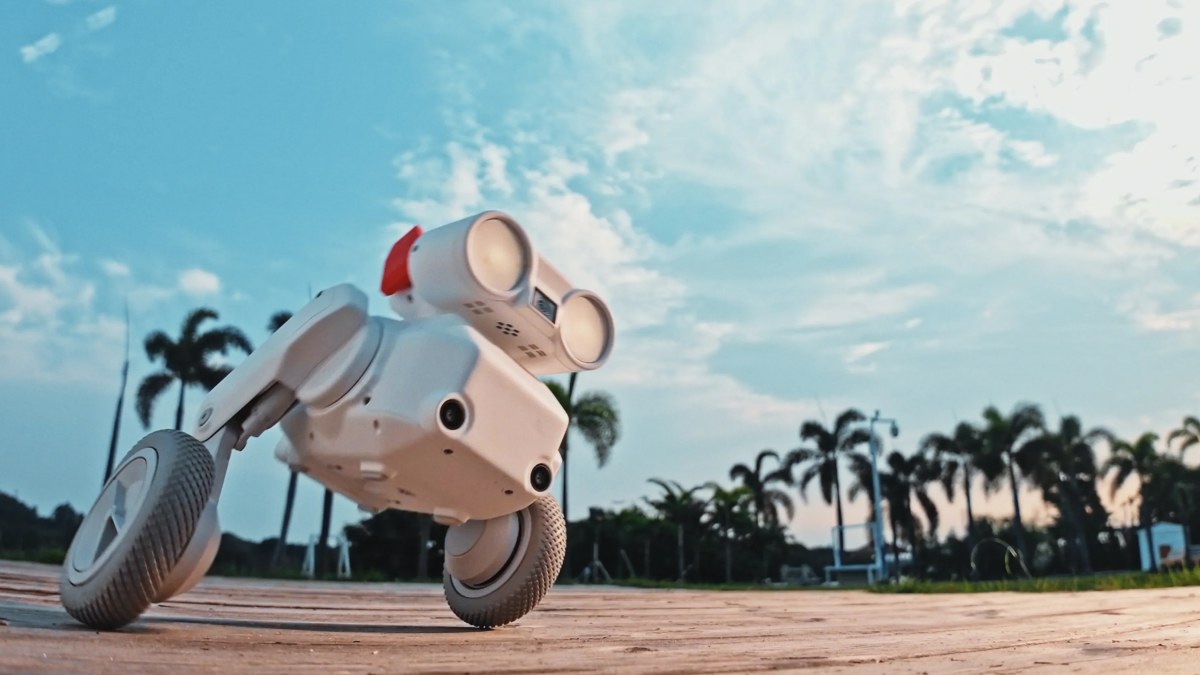
A team of DJI veterans decided the next frontier in camera stabilisation is not a better gimbal. It is a robot that can keep up with you while you move.
Beni is a two-legged camera robot, small enough to fit in a backpack, fast enough to chase you at nearly 18 miles per hour, and springy enough to hop up stairs and clear 10-inch obstacles. The Kickstarter project from Mondo, a startup staffed by engineers who cut their teeth on DJI's gimbal systems, is already opening orders at $600 ahead of a planned $800 retail price. The company says it will ship this fall.


The basic pitch is simple: instead of carrying a camera or flying a drone, you let a robot carry the camera for you. But the execution is anything but simple. Beni is a purpose-built machine that had to solve problems that neither a handheld gimbal nor a drone quite faces: how to run over rough ground, how to climb, how to fall without breaking the camera, and how to feel like something worth trusting with the shot.
WHAT OR WHO IS A BENI?
Beni looks like a small animal with a camera head mounted between two articulated legs. The legs are the interesting part. Motors in the shoulders fling the lower legs downward, and spring-filled cylindrical joints absorb the shock of each footfall. When Beni trips (and it does trip, as the demo showed), it immediately recovers by rotating its legs back under its body and standing up. The result is something that does not look like a drone on legs. It looks like a creature figuring out terrain.
The camera payload shoots super-stable 4K30 HDR, or 3K60, or 1080p100 for slow-motion work. That is the DJI heritage showing: the stabilisation is the point. Beni does not need a gimbal because the whole robot is the stabilisation system, adjusting leg position and body angle in real time to keep the frame level across bumps, stairs, and turns. Anyone who has watched a handheld chase cam struggle to hold composition while the operator runs knows exactly why this matters.
Battery life runs up to 1.5 hours per charge, which is not great for a full shoot day but is about right for a run, a hike, or a skate session. The tradeoff is the weight and size needed to make the legs work. Pack an extra battery if the shoot runs long.
NAVIGATION IS THE HARD PART
You can control Beni with virtual joysticks on a phone or with a bundled physical controller, and it supports third-party controllers as well. The robot has obstacle avoidance cameras and an ultra-wideband wrist tracker for follow mode. In the demo, however, the obstacle avoidance was not quite bulletproof. The robot crashed into things. The important detail is that it always bounced back. Mondo's marketing director Cody Skene and creative director Ryo Miyamoto showed how Beni rights itself after a fall and keeps going. In practice, that might matter more than perfect avoidance. A camera robot that stops dead at every obstacle is useless for dynamic shots. One that occasionally bumps into things but keeps running is still useful.
The follow mode is the real attraction for most shooters. Beni can follow down multiple flights of stairs while keeping the subject framed. That alone would be extremely hard to pull off with a handheld camera without a dedicated operator on a stabiliser rig. The question is how well the follow mode works in uncontrolled conditions: crowds, changing light, reflective surfaces. The UWB tracker helps by keeping a lock on the wristband, but the obstacle cameras have to handle everything else.
PERSONALITY AS A FEATURE
Robots that you want to keep around need to feel less like appliances. Mondo seems to understand this. Beni has been given deliberate personality cues. The fact that it can look with its head before turning its body helps it seem alive. You can pet it on the head, and it responds by jumping or shaking or cooing at you while flashing colourful lights. None of this serves the camera mission. It all serves the same function that a dog's tail wag serves: it makes you want to keep the thing around rather than stuffing it in a closet after the novelty wears off.
That matters because an $800 robot camera is a niche device. The people who will buy it are creators, athletes, filmmakers, and gadget enthusiasts who will interact with it regularly. If Beni feels like a tool, it stays in the case. If it feels like a companion, it travels with you everywhere, and Mondo gets the kind of social proof no ad campaign can buy.
THE DJI CONNECTION, AND WHAT IT BRINGS
The robot comes from DJI veterans, and that pedigree is visible in the stabilisation algorithms and the camera hardware choices. But Mondo's Skene is careful to clarify that the company has no other connection to DJI. Beni is entirely manufactured in-house, not in DJI's factories, and Mondo is a fully independent startup. The veterans brought the knowledge; they did not bring the supply chain.
That independence matters for credibility. A Kickstarter project from a relatively unknown startup is asking for $600 preorders with no track record. The DJI connection buys trust for the camera and stabilisation claims. It does not buy trust for the delivery timeline, the battery longevity, or the durability over months of use. Skene is confident Beni will ship this fall, and the all-in-house manufacturing gives Mondo more control over the timeline than outsourcing would, but Kickstarter is still Kickstarter. Backers know the math.
WHAT COMES NEXT
Mondo has already sketched a few add-ons that hint at a broader platform. A 4G dongle for the Chinese market will let Beni roam without a phone. The company plans to provide 3D printer files for additional camera mounts and body armour, which opens the door to community-designed accessories. Mondo might even add a treat-tosser for your pets, turning Beni into a roving pet entertainer when it is not shooting video.
None of these features is shipping with the initial unit, but the platform approach is smart. The robot has a capable body, a known stabilisation baseline, and a modular camera head. The same chassis could carry different sensors, different lenses, or different payloads entirely. A thermal camera version for search and rescue or a lidar version for mapping are not hard to imagine.
For now, the target is clear: action sports, run-and-gun filmmaking, and anyone who has ever lost a drone to a tree branch and wished they had something that could just walk around the obstacle. Beni will not replace a drone for aerial shots, and it will not replace a gimbal for controlled studio work. But for the gap between those two worlds, the one where the camera operator is also the subject, Beni might be the most interesting option on the table.

The fall shipping date is the test. If Mondo delivers on time with a robot that shoots as well as it runs and runs as well as it recovers from a crash, the DJI veterans will have built something the drone industry never quite got right: a ground robot that moves like an athlete and shoots like a pro.
what did you make of it?
more from ai
ai
TSMC ADDS $100 BILLION TO ARIZONA CHIP BET, TOTAL HITS $265 BILLION
The additional investment will build at least four more 2nm fabs and advanced packaging, bringing the company's total US commitment to $265 billion.
ai
META WILL ALERT PARENTS IF TEENS DISCUSS SUICIDE WITH META AI
The opt-in feature flags self-harm references in chatbot conversations, with human review before any notification is sent.
ai
ROBLOX'S "BUILD" LETS ANYONE MAKE A GAME FROM THEIR PHONE WITH AI
The new toolset, launching July 28, turns text prompts into playable experiences and puts game creation on iPhone and iPad.
ai
ZOOX REALLS ENTURE ROBOTAXI FLEET OVER SMOKE DETECTION FAILURE
A robotaxi drove into an active fire scene obscured by smoke. NHTSA called emergency scenes not edge cases.